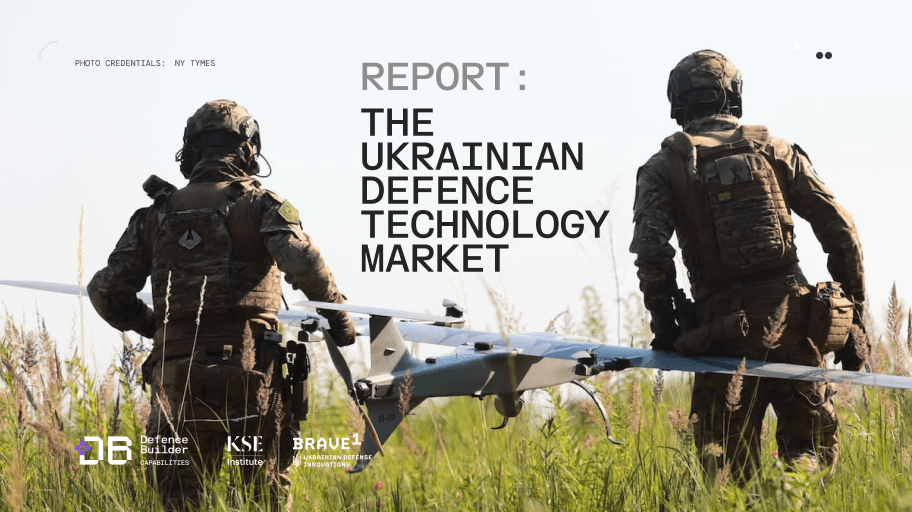

KSE Institute, Defence Builder, and Brave1 have released a study on how Ukraine's defence technology market — one of the most dynamic segments of the economy — has taken shape under conditions of full-scale war, and what opportunities it presents for American and international investors.
Access the Full Report: "The Ukrainian Defense Technology Market: Opportunities for US Investors"
In 2025, the volume of Ukraine's defence technology market reached at least $6.8 billion. Overall defence production grew more slowly due to limited domestic financing, while technology segments developed significantly faster: UAV y-o-y rate increased by 137%, ground robotic systems by 488%, and electronic warfare systems by 215%. The real market size is higher, as a significant portion of procurement occurs through decentralised channels — charitable foundations, direct unit contracts, and brigade-level manufacturing — none of which appears in official statistics.
The study identifies three key segments with the greatest investment potential.
The UAV segment is the largest and most mature — $6.3 billion in 2025, with more than 150 active manufacturers. Long-range drones are the fastest-growing subsegment (+169%). FPV drones remain the highest-volume subsegment (+110%) and simultaneously the most competitive, with constant pressure on price and quality. A defining trend of 2025 is the rapid development of fibre-optic FPV drones as a response to intense EW conditions. Emerging directions include interceptors, which are only beginning to scale: the number of successful intercepts grew, as well as middle-strike systems and domestically produced reconnaissance multicopter alternatives to Chinese DJI and Autel platforms.
The unmanned ground vehicles segment is forming rapidly, though it remains relatively small — $252 million in 2025, six-fold growth over the year. Logistics and evacuation platforms are the primary driver: they account for 61% of the market and grew by 556% — this is the most scalable use case with confirmed battlefield demand. Strike systems and demining platforms are opening new niches with significant long-term demand — particularly given the scale of mine contamination across Ukrainian territory.
The EW segment enables the effectiveness of all other technologies — $220 million, with 3.1x growth. Notably, an entirely new subsegment has emerged — systems countering precision-guided munitions — reaching 19% of the market within a single year. The market is transitioning from fragmented solutions to serial production of proven platforms, and investment value is increasingly concentrated in integrated, interoperable architectures rather than individual devices.
Technological development is focused on four directions:
EW-resistant multi-layer communications,
AI-based and inertial alternative navigation,
Autonomy — from automatic target recognition to early drone swarm coordination solutions,
Modular integration, where drones evolve from standalone products into interconnected platforms.
In 2025, Ukrainian defence companies raised at least $129 million in investments and grants — the real figure is higher, as some deals remain undisclosed for security reasons. The largest volume of investment is concentrated in the AI and software segment. Brave1 distributed over $60 million in grant funding among more than 600 companies; the "5-7-9%" programme provided $160 million to 108 enterprises of defence significance. The long-term reconstruction and development potential of the defence sector over a 10-year post-hostilities horizon is estimated at $690 billion.
The market analysis is part of the systematic work of DB Capabilities — the analytical arm of Defence Builder, researching the structure and dynamics of Ukraine's defence technology market. Its mission spans three dimensions: building the evidence base for investment decisions by ecosystem partners and investors; ensuring quality selection of companies for DB Accelerator and DB Fund based on deep understanding of market realities; and developing an independent Ukrainian analytical position in the international discourse on defence technology development.